45 Brain Games, Puzzles and Brain Health: 2026 Statistics (Updated September)
The first time I came across a sudoku puzzle I was flabbergasted: my grandma was playing with a booklet and a pencil in bed. She had a legal pad on the side, thousands of annotations and scratch-offs. I remember being really young and hating math so I immediately rejected it, until… she explained it was about “outsmarting the square”. What a genius granny is —I thought— she can beat math!
Then it hit me, it’s strategy and not “math”, it’s knowing what you’re surrounded by and how to manage the big and small pictures all at once. What a joy my grandma gifted me. Hours of doing nothing but exercising my lobes without even knowing it.
Puzzles and games can be enjoyable forms of mental exercise, but “brain health” is broader than any single activity. Crosswords draw on language and recall, Sudoku and number puzzles use logic and working memory, jigsaws recruit visuospatial skills, strategy games involve planning, and some digital programs train specific cognitive tasks.
The evidence is equally varied. Some studies compare an intervention with a control group, while others observe that people who often play games or solve puzzles perform differently on cognitive tests. An association does not prove that the activity caused the difference, and improvement on a trained task may not transfer to everyday thinking. This compilation made by Sudoku a Day keeps those distinctions visible.
Key takeaways
- A 2026 board-game review screened 5,288 records and retained 24 studies. The steep reduction shows how selective the evidence becomes after quality and relevance checks. (Applied Psychology: Health and Well-Being, August, 2026)
- A 2025 serious-game memory review included 18 studies and pooled 16. The evidence base is substantial enough for synthesis, while study design still varies. (Games for Health Journal, December, 2025)
- Serious games produced an overall memory effect of SMD 0.35 in healthy older adults. This represents a modest average improvement across the included trials. (Games for Health Journal, December, 2025)
- A 2024 computer-gaming cohort followed 471,346 adults and recorded 7,898 dementia cases. Its scale strengthens precision, while the observational design limits causal conclusions. (Alzheimer’s Research & Therapy, June, 2024)
- Active mental activities were associated with a 9% lower dementia risk in 10,318 older adults. Games, cards, chess, crosswords and puzzles were grouped together, so the estimate cannot be assigned to one activity. (JAMA Network Open, July, 2023)
- A 2025 cognitive-leisure study followed 3,326 adults aged 65 or older over a 12-year design. The seven-year lag reduced, without eliminating, concern about reverse causation. (Age and Ageing, October, 2025)
- A board-game wellbeing study retained 132 older adults with a mean age of 74.05 years. Participants reported higher wellbeing during play than in daily life, an immediate experience rather than a clinical treatment effect. (Frontiers in Psychology, November, 2024)
- A 2025 modern-board-game trial enrolled 30 nursing-home residents for 12 weeks. The small sample makes the results promising and preliminary. (Games for Health Journal, December, 2025)
- A 2026 digital-game review covered 28 studies and 1,201 participants. Executive and motor outcomes appeared most consistently improved, with mixed findings elsewhere. (Games for Health Journal, February, 2026)
- A 2023 attention review retained 10 trials from 559 records. The authors rated the evidence very low quality, which materially limits confidence. (npj Digital Medicine, July, 2023)
Brain games and mental agility statistics
Mental agility can include reasoning, processing speed, executive function and flexible problem-solving. The bullets keep each result tied to its measured outcome and study population.
Reasoning and problem-solving
- Frequent computer gaming was associated with fluid-intelligence β = 0.334 versus rare or no play. The result signals a relationship with reasoning performance and remains observational. (Alzheimer’s Research & Therapy, June, 2024)
- Modern board games improved comprehension by 9.9% in a 30-person nursing-home trial. The result suggests task-relevant cognitive stimulation and needs replication in larger samples. (Games for Health Journal, December, 2025)
Executive function and cognitive flexibility
- Digital games were reviewed across 28 studies with a mean participant age of 71.57 years. Executive function showed the most consistent cognitive improvement, although results varied by intervention. (Games for Health Journal, February, 2026)
- A board-game synthesis reported MoCA P = 0.003 and MMSE P = 0.02. Cognitive-test improvement in selected studies does not establish dementia prevention. (Journal of Alzheimer’s Disease, September, 2023)
- The modern-board-game trial reported an 83.3% improvement in attention and calculation. The unusually large percentage comes from 16 intervention participants and should be read cautiously. (Games for Health Journal, December, 2025)
Processing speed and practice effects
- The 2026 board-game meta-analysis reported significant processing-speed results in older adults. High heterogeneity means the direction is encouraging while the precise size remains uncertain. (Applied Psychology: Health and Well-Being, August, 2026)
- Frequent gamers had faster reaction-time performance, β = -0.195, in the UK Biobank analysis. Faster test responses accompanied gaming frequency, without proving training transfer. (Alzheimer’s Research & Therapy, June, 2024)
Games and memory statistics
Memory includes working, episodic, verbal and visuospatial functions. Each statistic below names the specific memory domain used by the source.
Working memory
- Intensive digital cognitive training produced a working-memory effect of SMD 0.93. This sizable pooled estimate applied to older adults with MCI or dementia in 10 randomized trials. (Psychiatry Research, June, 2025)
- Serious games produced SMD 0.09 for working memory, with a 95% confidence interval from -0.09 to 0.27. The interval crosses zero, so this specific memory result was inconclusive. (Games for Health Journal, December, 2025)
- Frequent computer gaming was associated with numeric-memory β = 0.107. The association is compatible with better working-memory performance and cannot establish causation. (Alzheimer’s Research & Therapy, June, 2024)
Episodic, verbal and visual memory
- Intensive digital training produced an episodic-memory effect of SMD 0.87. The result was positive in a clinical older-adult population and may not generalize to healthy players. (Psychiatry Research, June, 2025)
- Serious games produced SMD 0.77 for visuospatial working memory and SMD 0.34 for verbal memory. The contrast suggests outcomes depend strongly on the memory domain. (Games for Health Journal, December, 2025)
- Exergame interventions produced a memory effect of g = 0.179 with P = 0.060. The trend fell short of conventional statistical significance. (Frontiers in Aging Neuroscience, May, 2026)
Memory outcomes in older adults
- A 2025 board-game trial reported a 22.6% improvement in remote memory. The finding came from nursing-home residents and remains preliminary because only 30 people enrolled. (Games for Health Journal, December, 2025)
Games, concentration and attention statistics
Attention evidence covers sustained, selective and task-specific performance. Brief interpretation in each bullet separates measured change from wider claims about everyday concentration.
Attention and information processing
- A 2025 serious-game review included 1,698 older adults with MCI. The participant count provides a broader attention evidence base than the smaller single-game experiments. (Age and Ageing, April, 2025)
- Three trials in the 2023 serious-game meta-analysis favored games over passive controls at P < 0.001. The statistical signal was strong while the underlying evidence quality was rated very low. (npj Digital Medicine, July, 2023)
Games and mental wellbeing statistics
Wellbeing studies may measure immediate enjoyment, stress, mood, social connection or quality of life. These outcomes remain distinct from clinical treatment.
Stress, relaxation and flow
- An open-world gaming study surveyed 609 players and interviewed 32 postgraduate students. The mixed-methods design adds personal context to an observational model. (Journal of Medical Internet Research, December, 2024)
- Board-game wellbeing was higher during play, F(1,131) = 14.604 with η² = 0.100. The medium-sized immediate difference supports enjoyable engagement rather than a lasting health claim. (Frontiers in Psychology, November, 2024)
- Cognitive escapism predicted relaxation at β = 0.15, while relaxation predicted wellbeing at β = 0.12. The pathway is statistically significant and does not establish a therapeutic effect. (Journal of Medical Internet Research, December, 2024)
Mood, loneliness and quality of life
- Active-video-game research retrieved 3,471 articles and retained 17 randomized studies. The evidence covers stress, anxiety, depression and happiness across varied interventions. (BMC Public Health, December, 2024)
- Game therapy reduced depression with SMD -0.70 in a 2026 network meta-analysis. The result concerns clinical MCI and dementia populations rather than ordinary recreational play. (International Journal of Nursing Studies, August, 2026)
Social play and cognitive engagement
- Modern board games improved interpersonal-relationship scores by 15.4% and social inclusion by 6.3%. The gains suggest social value in facilitated group play within one small nursing home. (Games for Health Journal, December, 2025)
- Board-game sessions used groups of four or five across a final sample of 132 older adults. The format makes social interaction part of the experience being measured. (Frontiers in Psychology, November, 2024)
Games, puzzles and healthy aging statistics
Healthy aging research often combines cognitive, social and physical activity. Longitudinal associations remain vulnerable to reverse causation even when studies use time lags and extensive adjustment.
Cognitive leisure and healthy aging
- A 2024 multi-cohort analysis included 33,263 adults and 1,408 dementia cases over a mean seven years. Its scale supports precise associations across several leisure categories. (Age and Ageing, July, 2024)
- A 2023 cohort included 10,318 older adults with a median age of 73.8 years. The population scale supports stable estimates while the activity data remained self-reported. (JAMA Network Open, July, 2023)
- Active mental activity was associated with HR 0.52 in follow-up shorter than 10 years. The association weakened over longer follow-up, which raises concern about preclinical disease affecting participation. (Age and Ageing, July, 2024)
Mild cognitive impairment and dementia research
- Moderate cognitive-leisure engagement was associated with dementia HR 0.50 and high engagement with HR 0.53. The similar estimates suggest no simple dose-response pattern. (Age and Ageing, October, 2025)
- Computer gaming “sometimes” was associated with dementia HR 0.90 and “often” with HR 0.81. The trend remained observational despite extensive adjustment. (Alzheimer’s Research & Therapy, June, 2024)
- Video-game interventions increased MoCA scores by a mean 2.58 points in older adults with MCI. The estimate applies to five small randomized trials and requires cautious interpretation. (Frontiers in Aging Neuroscience, January, 2026)
What different games have been studied for
The evidence differs sharply by game type. Each bullet states the activity studied, the outcome measured and the practical limit of the result.
Crosswords, chess, cards and strategy games
- Frequent crossword engagement showed one of the strongest independent associations in a 3,326-person French cohort. The study used a seven-year lag, yet residual confounding remains possible. (Age and Ageing, October, 2025)
- Chess improved WHOQOL-OLD scores at P < 0.00001 in the 2023 board-game review. The result concerns quality of life in selected studies and cannot rank chess above other games. (Journal of Alzheimer’s Disease, September, 2023)
Jigsaw, Sudoku and number puzzles
No Sudoku-specific or jigsaw study located for this update met every inclusion rule, so this section does not assign broader puzzle findings to either activity.
Digital brain games and cognitive training
- A network meta-analysis screened 1,189 records and included 10 randomized trials. Intensive training produced large cognitive estimates in older adults with MCI or dementia. (Psychiatry Research, June, 2025)
- A 2025 serious-game meta-analysis included 28 randomized trials. The larger recent evidence base strengthens comparison across digital formats while intervention differences remain important. (Age and Ageing, April, 2025)
Brain games compared
Research coverage varies substantially by activity, population and measured outcome.
| Game type | Memory | Attention | Reasoning and executive function | Wellbeing and social connection | Recent evidence |
|---|---|---|---|---|---|
| Crosswords and word puzzles | Language recall and cognitive aging | Task focus | Verbal retrieval and problem-solving | Primarily individual leisure | 2025 observational cohort |
| Chess, cards and strategy games | Remote memory in one small trial | Planning and sustained attention | Executive function | Group play and quality of life | 2023 review, 2024 observational study and 2025 trial |
| Jigsaw and general puzzle games | Plausible visuospatial and working-memory demands | Task attention | Visuospatial reasoning | Limited direct recent evidence | No qualifying 2023–2026 outcome study included |
| Sudoku and number puzzles | Working-memory demands | Sustained focus | Logic and constraint solving | Limited direct recent evidence | No qualifying Sudoku-specific 2023–2026 outcome study included |
| Digital brain games | Working, episodic, verbal and visuospatial memory | Mixed by program | Executive function and processing speed | Some relaxation and mood research | Multiple 2023–2026 reviews and trials |
What does science say about games and brain health?
Recent research supports specific, population-bound conclusions. Effect sizes vary across cognitive domains, and observational associations require careful interpretation.
What the evidence supports
- Recent exergame evidence found overall cognition g = 0.135 across 690 participants. The small pooled effect illustrates why practical claims should stay measured. (Frontiers in Aging Neuroscience, May, 2026)
- Game therapy produced a global-cognition effect of SMD 0.71. The network estimate supports a domain-specific result for people with MCI or dementia. (International Journal of Nursing Studies, August, 2026)
What remains uncertain
The evidence has yet to establish the best game, an ideal everyday dose or reliable transfer to daily functioning. Healthy adults, people with MCI and people living with dementia also represent distinct populations.
Unsupported claims
No evidence presented here establishes that a puzzle prevents dementia, makes everyone smarter or treats anxiety or depression. Observational results may reflect prior ability, health, education, social participation and early disease changes.
Methodology and source notes
Every source in this version was published from January 2023 through August 2026. The evidence set prioritizes peer-reviewed research, systematic reviews, meta-analyses, randomized studies and large prospective cohorts.
Each statistical finding includes a source link and a brief interpretation. Results are grouped by cognitive domain, activity and study population.
Sudoku-specific evidence is labeled separately from general puzzle, crossword, board-game and digital-training evidence. Observational associations are described as associations, and intervention findings stay tied to the population, duration and outcome studied.
Choose a brain game that fits your routine
The most practical brain game is one you enjoy and can return to without pressure. Variety can include puzzles, physical activity, sleep, social connection and cardiovascular care.
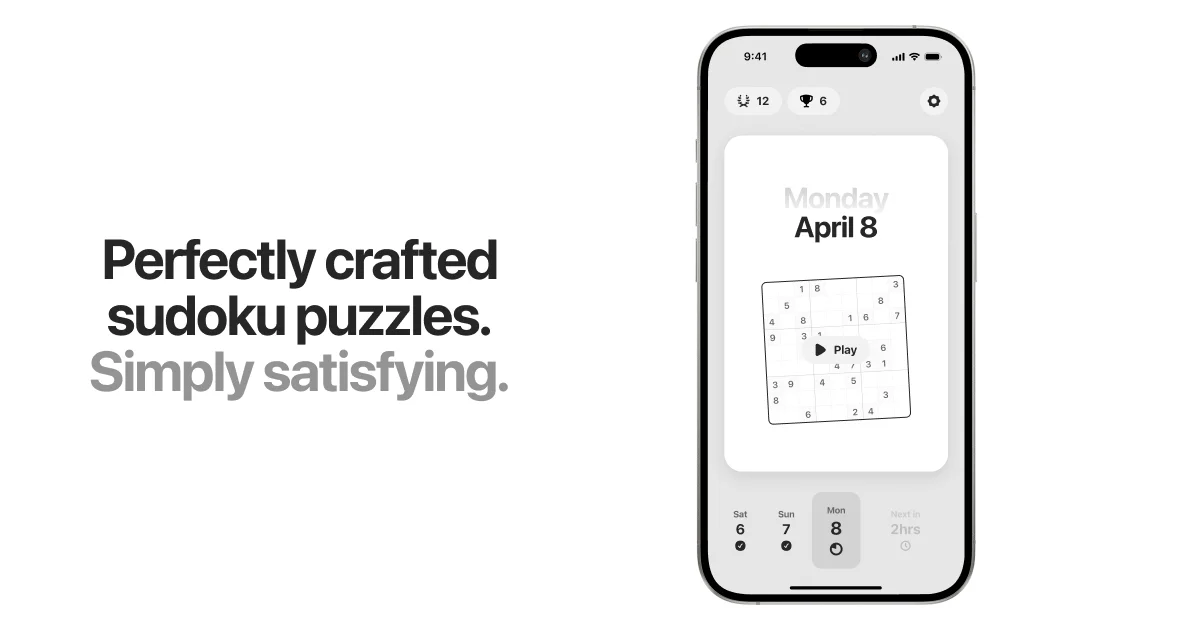
If logic puzzles suit your routine, Sudoku a Day offers a fresh, ad-free daily puzzle. You can also use the how-to-play guide or browse printable Sudoku packs. Enjoy the challenge with no medical promise.